
News Release
- TOP
- Information
- Release of GDSDX, a New Platform for Sharing and Exchanging Content and Musical Works Information from the World's Leading Digital Distribution Services


On May 31, 2023, the Japanese Society for Rights of Authors, Composers and Publishers (JASRAC) released and began operating the GDSDX, a platform for sharing and exchanging content information from global video and music distribution services and information managed by copyright management organizations.

1. Progress and issues
In recent years, the amount of royalty income in the interactive transmission field for musical works managed by JASRAC has been increasing, and the proportion of interactive transmission use in the total amount collected (129.01 billion yen) was 34.6% (44.66 billion yen) in FY2022 (reference: press release of May 24, 2023). In particular, since global music subscription and video distribution services allow users to listen to a vast amount of music around the world, ensuring the collection of copyright royalties as compensation for use has become an important issue and concern for creators, rights holders, and other parties involved in the music industry in Japan.
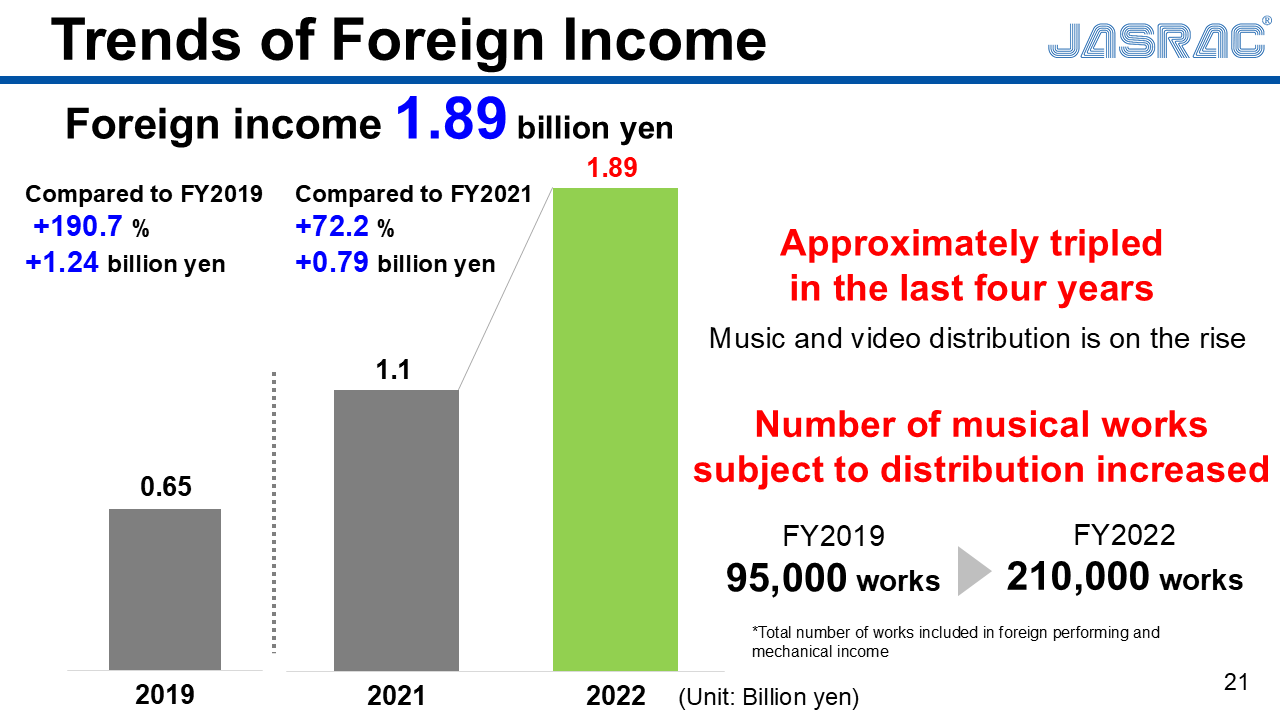
Digital music distribution service providers (DSPs) sign contracts with music copyright management organizations such as JASRAC in each country and region, and pay royalties for the use of musical works while also reporting on the use of those works. JASRAC manages musical works through agreements with copyright management organizations in each country and region. For example, when musical works administered by JASRAC are used overseas, the local management organizations receive royalty payments from DSPs and remit them to JASRAC, which then distributes the royalties to creators and rights holders in Japan (*1). The amount of royalties remitted from overseas to JASRAC in FY2022 was 1.89 billion yen, which is approximately three times the amount in FY2019, before the COVID-19 pandemic.
On the other hand, as music subscription and video distribution services use a huge number of musical works, the identification of musical works for royalty distribution is a challenging process.
Based on the reports received from users of musical works used in many fields, including performance, broadcasting, interactive transmission and reproduction, JASRAC identifies the administered works and distributes royalties to the rights holders based on the rights relationship (distribution ratio, etc.) that have been reported by the trustors. A total of 3.24 billion reports have been received annually, of which 93.5%, or 3.03 billion, are from the interactive transmission field (FY2022).
In the field of interactive transmission, musical works are identified based on the reported sound source information, ISRC (International Standard Recording Code), as well as on the musical works information such as title, writers, artists, etc. (such information is referred to as "metadata"). If the work is unable to be identified by the system, it will be identified by a specialist staff. As a result, the identification rate for musical works (*2) at JASRAC is 95.3% (FY2022) for music subscriptions.
In Japan, reporting data is efficiently prepared by utilizing the CDC (Copyright Data Clearinghouse), mainly by large-scale streaming services such as music subscription providers. Once a musical work has been identified, an identifier (work code) for the musical work is assigned to the reported data, which is then fed back to the streaming services provider. The accuracy of the data is also ensured by the service provider including the work code in the reporting data for subsequent use. In this way, in Japan, compensation is being provided to creators and rights holders through the efforts of both streaming service providers and copyright management organizations.
However, due to the large number of newly distributed musical works, the portion of unidentified works (4.7%) is equivalent to approximately 9.5 billion requests (including public domain and non-administered musical works). Such identification of musical works in this type of distribution is a challenge not only globally but also in Japan.
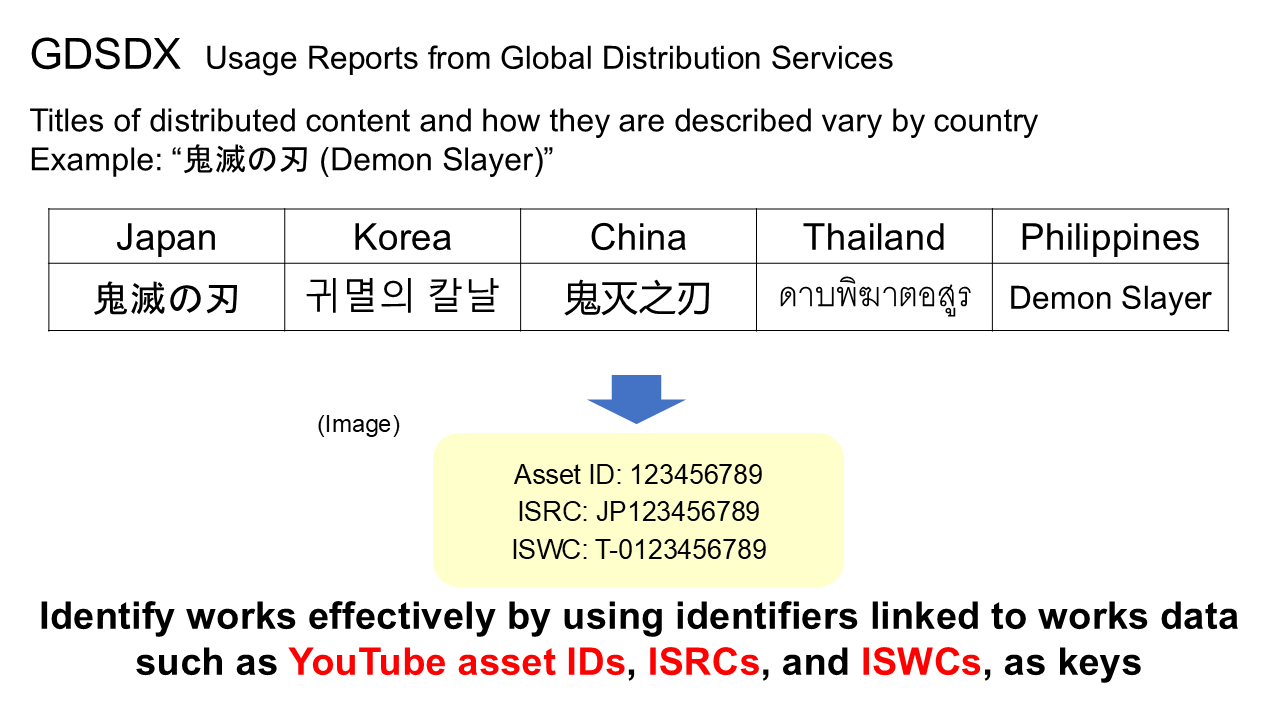
Among the challenges related to the identification of musical works, when musical works from one's own country or region is used overseas, there is often no information on the musical works that can be associated with the sound source information (ISRC) locally, and the conversion of titles to local notation makes identification by metadata difficult, especially when used in Asian regions, which has their own unique character systems. Therefore, in order to resolve this issue, JASRAC launched the GDSDX project in collaboration with FILSCAP (Philippines), KOMCA (Korea), MÜST (Taiwan), and WAMI (Indonesia), which are members of the CISAC Asia-Pacific Committee.
*1 In some cases, music publishers sign contracts with local companies for mechanical rights, and royalties are paid through these companies.
*2 The percentage of all requests that include musical works whose copyright protection period has expired (public domain) or that are not administered by JASRAC (non-administered musical works).
2. About GDSDX
GDSDX is a database that correlates information reported by each DSP on musical works administered by copyright management organizations such as JASRAC , , using the following two keys: (1) a unique code (see "Distributed musical works ID" below) created for each piece of content (music and video) distributed by each DSP, and (2) the ISRC for the sound source.
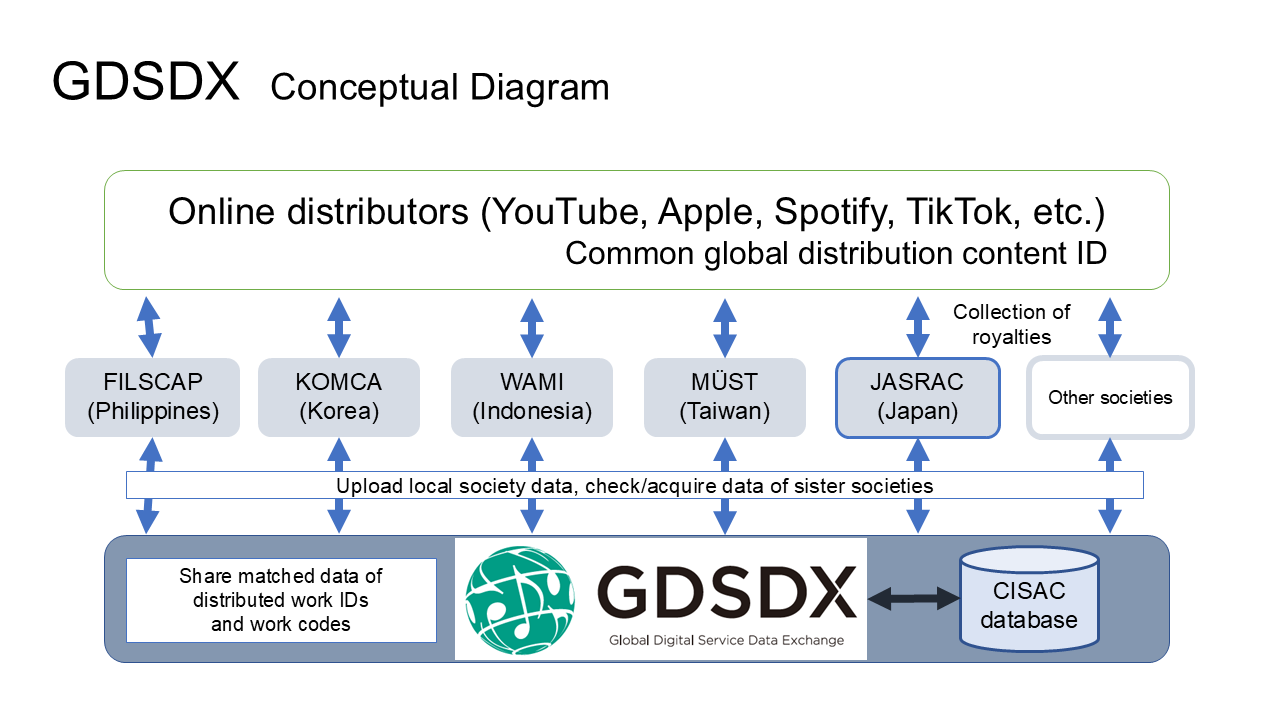
Each DSP reports the distribution work ID (see (1) above) that is globally used by each DSP to the copyright management organizations in each country and region, so it is possible to accurately identify the musical works used using this ID as a key. This makes it possible to accurately identify musical works even if the titles of works are converted to local notation in different regions through GDSDX. Furthermore, the ISWC (International Standard Musical Work Code) and work registration data (materials submitted by rights holders to copyright management societies) shared within CISAC will also be linked, which improves the efficiency of the work done by each organization up until the royalties distribution process.
3. Going forward
This launch has started with a total of 1.4 million pieces of musical works information, including 430,000 pieces of musical works administered by JASRAC and four other participating organizations, for YouTube, one of the distribution services that is expanding globally. In the future, the system is scheduled to be expanded to include other distribution services besides YouTube, such as Apple, Spotify, and TikTok.
GDSDX will begin operating as a portal system for the Asia-Pacific region and will continue to expand the number of participating organizations in cooperation with CISAC. This will improve the accuracy of identifying musical works and enable music creators and rights holders around the world to receive more precise royalty distribution.
CISAC and JASRAC held a joint press conference in Tokyo on April 6 to explain the challenges and initiatives related to compensating creators in the digital society, including GDSDX (reference: April 19, 2023 press release).
In the "Entertainment Contents ∞ 2023 - Last chance to change -" released on April 11 by the Japan Business Federation (Nippon Keidanren), the goal was set to "sustainably expand the presence of Japanese content around the world." JASRAC will also contribute to the development of Japan's content and music industries by promoting initiatives to promote the use of Japanese musical works around the world, starting with the GDSDX, and to maximize the compensation that can be obtained.